
Permanent and Temporary Disability in Vermont Workers' Compensation
If you’ve been hurt on the job in Vermont, you’re probably dealing with more than just physical pain. Medical bills, missed paychecks, and uncertainty about your future can quickly become overwhelming.
On top of that, the workers’ compensation terminology can be confusing. Injured workers often struggle to understand terms like permanent partial disability and temporary total disability.
This guide breaks down what those terms mean in plain English, so you can better understand your rights and what disability benefits you may be entitled to in a Vermont workers’ compensation claim.
Two Key Concepts: "Temporary vs. Permanent" and "Partial vs. Total"
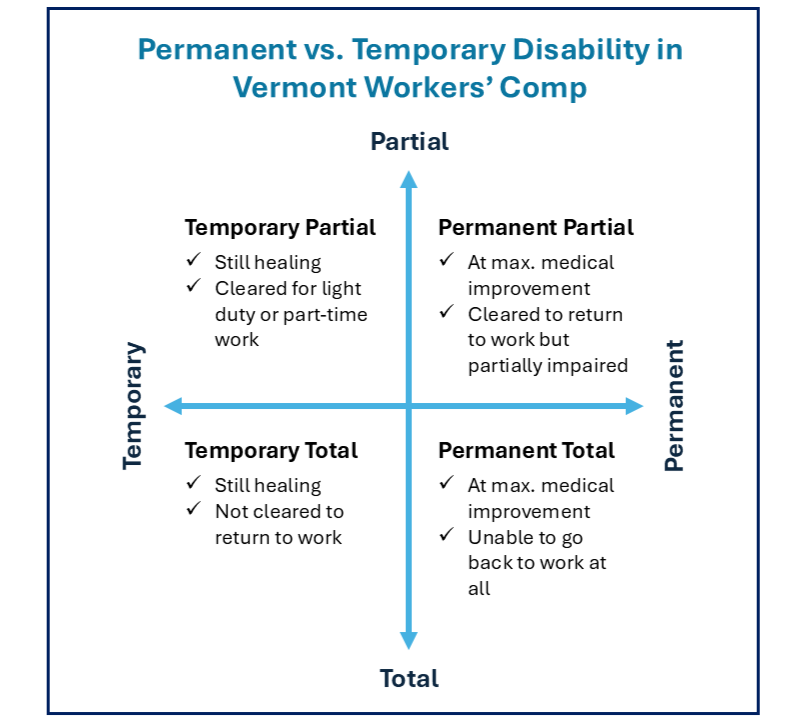
In Vermont, workers’ compensation disability benefits are divided into four main categories:
- Temporary partial disability (TPD)
- Temporary total disability (TTD)
- Permanent partial disability (PPD)
- Permanent total disability (PTD)
Each category answers two basic questions:
(1) Is your condition expected to improve?
- Temporary = You’re still healing
- Permanent = You’ve reached maximum medical improvement (MMI)
(2) Are you able to work?
- Partial = You can still work in some capacity
- Total = You cannot work at all
Let’s walk through each type.
Temporary Partial Disability (TPD)
What it means:
You can go back to work but not at full capacity. Your provider says
that you need to either work fewer hours or go on light duty.
Example:
After a knee injury, you return to work part-time or in a modified
role. With both of these options, you will likely be earning less than
your original job.
What you may receive:
- Partial wage replacement to make up some of the difference between your old wages and your current earnings
How long it lasts:
Until you improve physically or reach medical end.
Temporary Total Disability (TTD)
What it means:
You’re temporarily unable to work at all while you recover from your injury.
Example:
You suffer a serious back injury lifting something at work, and your medical provider says you cannot work at all for 8 weeks.
What you may receive:
- Wage replacement benefits (typically about two-thirds of your average weekly wage, subject to state limits)
- Coverage for medical treatment related to your injury
- In some cases, vocational rehabilitation benefits
How long it lasts:
Until you return to work or you reach medical end. This is the point at which your condition is not expected to improve any further. It is also sometimes called maximum medical improvement (MMI) or medical end result.
Permanent Partial Disability (PPD)
What it means:
You’ve recovered as much as you’re going to, but you have a lasting impairment that affects your ability to work in the same way as you did before you got injured.
Example:
You’ve healed enough to go back to work after a hand injury, but you’ve permanently lost some strength or mobility.
What you may receive:
- A permanency rating, which is a disability rating assigned by a doctor. The rating is based on American Medical Association guidelines for evaluating permanent impairments.
- Compensation payments based on that rating and how it affects your ability to earn a living
Important to know:
- Even if you’re back at work, you may still qualify for PPD benefits if you have a permanent limitation.
- It’s important to get a fair and accurate permanency rating, because your rating determines how much compensation you will get for your impairment.
Permanent Total Disability (PTD)
What it means:
Your injury is so severe that you are unable to return to any type of work on a long-term or permanent basis.
Example:
A traumatic brain injury or loss-of-limb injury that prevents any meaningful employment.
What you may receive:
- Ongoing wage replacement benefits
- Continued coverage of medical treatment related to the injury, including prescription medications
How long it lasts:
Potentially for life, depending on your situation.
Why These Categories Matter
The category your injury falls into—temporary or permanent, partial or total—directly affects:
- How much you’re paid in benefits
- How long the benefits last
- Whether you may qualify for additional compensation
Insurance companies may try to classify your injury in a way that limits what they must pay you. That’s why understanding these terms—and having so
meone on your side to advocate for you—can make a big difference.
What Should You Do After a Work Injury?
If you’ve been injured at work in Vermont:
- Report the injury to your employer as soon as possible
- Seek medical treatment and follow your provider’s instructions
- Keep records of missed work and medical visits
- Consider speaking with an experienced workers’ compensation attorney
Final Thoughts
Navigating a work injury is tough enough without having to decode legal jargon. Whether your condition is temporary or permanent, partial or total, it’s important to make sure you receive the full benefits you’re entitled to under Vermont law.
If you’re unsure about your classification, or if your benefits have been denied or reduced, it may be time to get legal guidance. The right support can help you focus on what matters most: your recovery.
Call now at 802-229-5146. It will cost you nothing to ask us about permanent disability and temporary disability in a Vermont workers' compensation claim.